Mental Models for the AI EconomyWeb & AI Search
The 12-Point Website Audit Every Business Owner Can Run in 20 Minutes
Speed, SEO, conversion, and AI-readiness — twelve checks you can run yourself before hiring anyone.
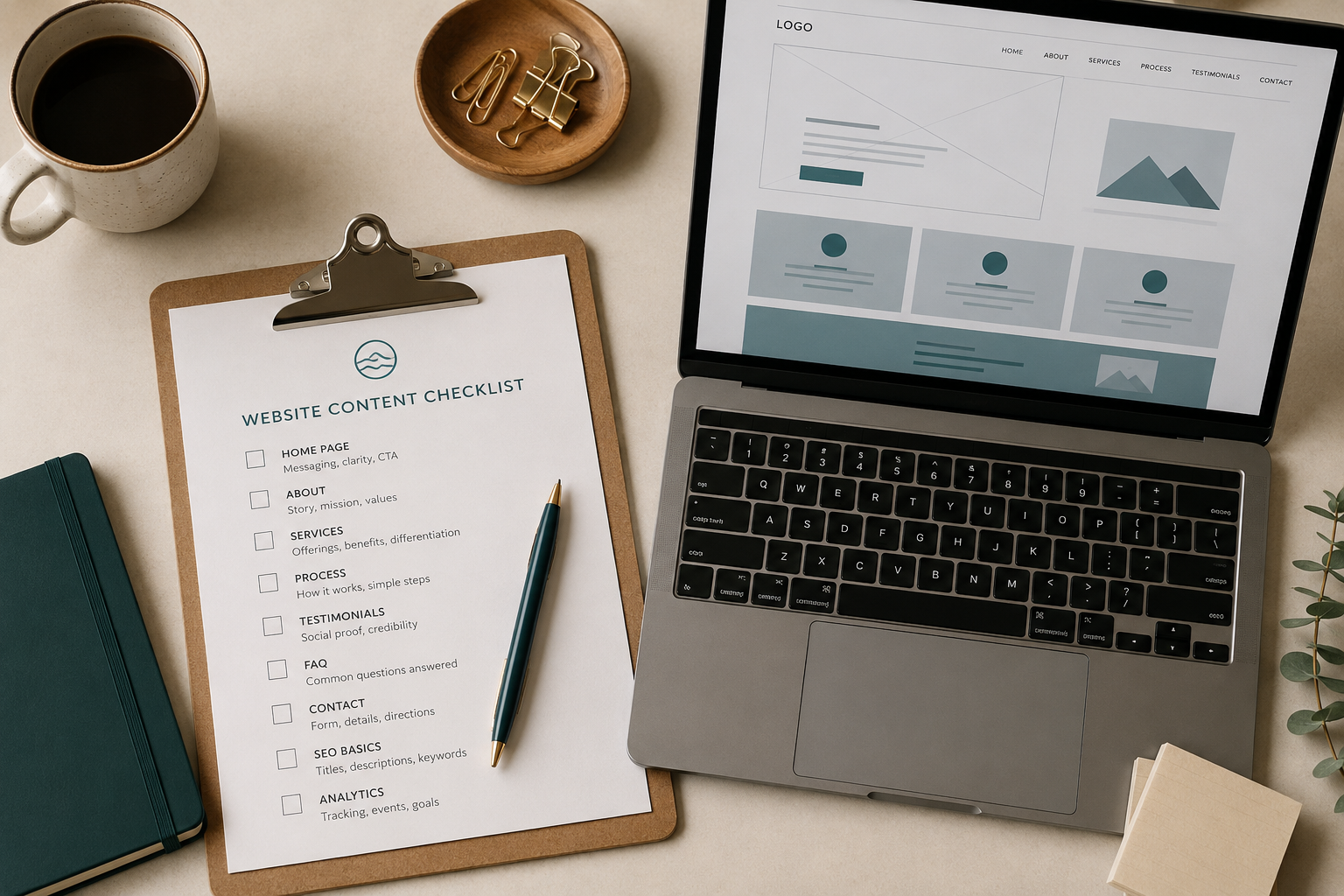
You don't need a consultant to know whether your website is helping or hurting your business. You need twenty minutes, a phone, and a browser. Here are twelve checks — grouped into speed, SEO, conversion, and AI-readiness — that a business owner can run without any tools beyond what's free on the web.
Group 1 — Speed (the deal-breaker)
1. PageSpeed score
Open pagespeed.web.dev and paste your homepage URL. Look at the Mobile tab. A score under 60 means Google is actively demoting you; between 60–89 is workable; 90+ is competitive.
2. Image weight
Right-click any hero image and check its file size. If it's over 300KB on a small screen, someone shipped a desktop-sized image to a phone. This is the single most common cause of slow sites.
3. Mobile load on real cellular
Turn off Wi-Fi and load your homepage on your phone. If it takes more than 3 seconds to show something readable, you're losing visitors before you meet them.
Group 2 — SEO fundamentals
4. Title tag
Look at the browser tab. Does it say your business name and a real value proposition, in under 60 characters? "Home | Acme" is a wasted slot.
5. One H1 per page
Right-click, "View Page Source," and search for <h1. You should find exactly one per page, and it should describe the page — not the site.
6. Schema present
Paste your URL into Google's Rich Results Test. If no structured data is detected on your homepage or service pages, you're invisible to the machines that summarize the web.
7. Indexed pages
Google site:yourdomain.com. If fewer pages show up than you have, some content is either blocked or not being found.
Group 3 — Conversion
8. Above-fold offer clarity
Show your homepage to someone who's never seen it. Give them five seconds. Ask: "What does this business do, and what does it want you to do next?" If they can't answer both, the page is not doing its job.
9. Form length
Count the fields on your contact form. Over five and you're bleeding leads. Most businesses need name, email, and one qualifying question. Everything else can come later.
10. Click-to-call on mobile
Load your site on a phone. Is your phone number tappable? If a customer has to select, copy, and dial, you've added friction to the highest-intent action on your site.
Group 4 — AI-readiness
11. FAQ content in question form
Do you have real customer questions on your service pages, answered directly? Assistants pull from these blocks. If your site is all marketing prose, you're not answerable.
12. Fact density
Open your "About" or main service page. Highlight every specific fact — years in business, service area, response time, number of clients, price ranges. If you can't find five, the page is too vague to be quoted.
Scoring your results
Give yourself one point per check passed. 10–12: you're ahead of most local businesses. 7–9: a targeted refresh will move the needle fast. Under 7: a rebuild will pay for itself in ad efficiency alone.
Or skip the twenty minutes — the audit I run covers all twelve of these plus thirty more, including Core Web Vitals detail, schema validation, AI-citability testing across four assistants, and a prioritized fix list. You'll get the scorecard within two business days, and there's no obligation to hire.
Get the next essay the day it publishes.
A few a month, written from real builds. Unsubscribe in one click.

Senior product manager and builder — 15+ years shipping enterprise products (AT&T, BMW Group), now running his own with AI. These essays are field notes from that loop: what AI actually changes about work, product, and the economics underneath. Based in South Florida.
- Web & AI SearchHow to Write a Service Page That Ranks and Gets Cited by AI
One service per page, the service and city in the heading, the answer first, buyer questions as headings, proof, one next step and schema behind it. Seven rules and a quick test.
4 min read - Web & AI SearchNew Website Launch Week: The Checklist That Protects Your Rankings
Get found, lose nothing, test every form and phone link, confirm analytics, then tell Google and every directory. A day-by-day checklist for the week a new site goes live.
4 min read - Web & AI SearchHow HVAC Companies Get More Service Calls from Google and AI
In South Florida every AC call is urgent. Be the obvious answer when it fails: the pages that bring in calls, effortless calling, honest answers and a profile that stays current.
4 min read