Mental Models for the AI EconomyWeb & AI Search
Anatomy of a Landing Page That Actually Converts Ad Clicks
The six elements every ad-driven landing page needs, why sending traffic to your homepage burns money, and the Quality Score math behind it.
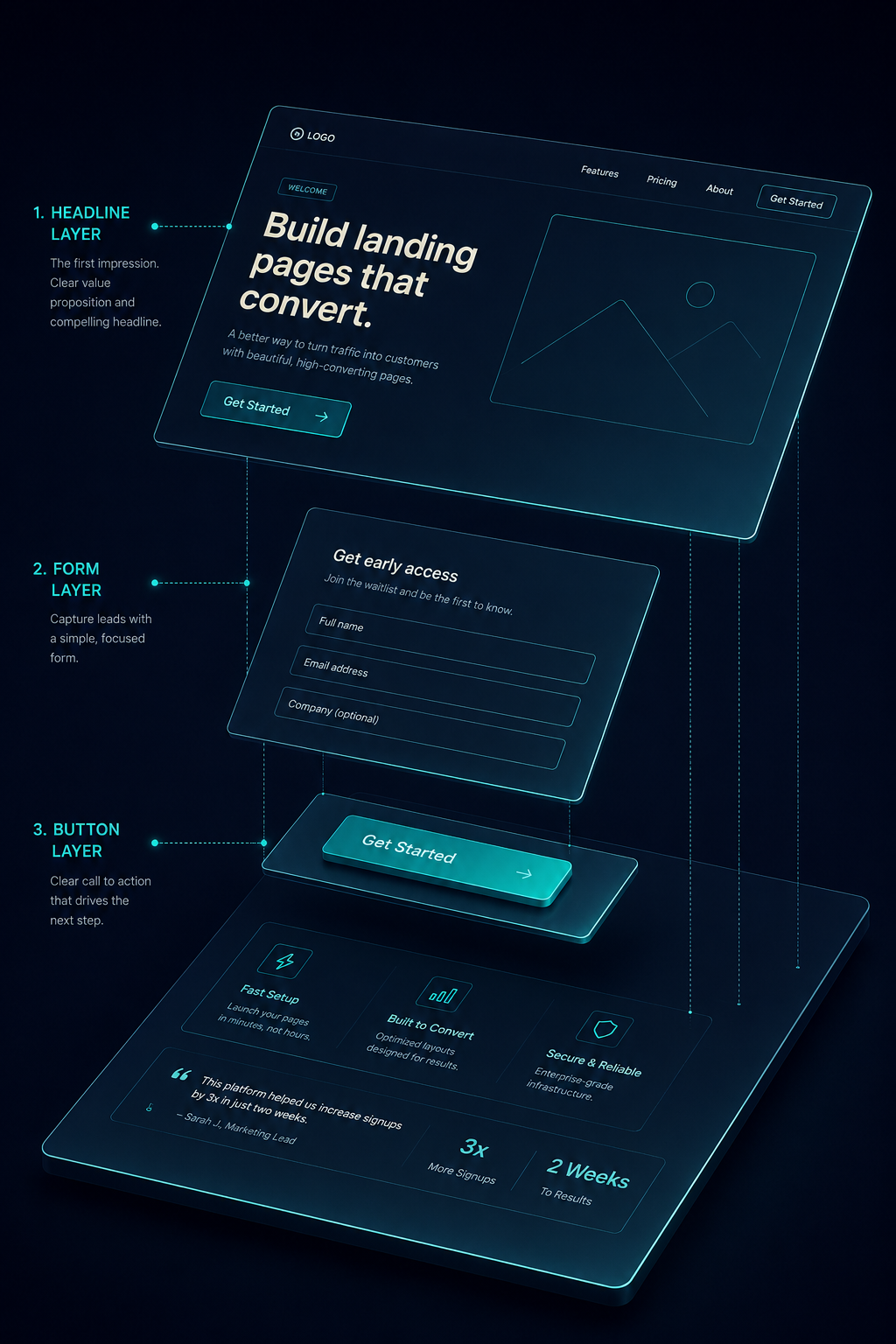
Here's an expensive habit most small businesses share: they run Google or Meta ads, then send every click to their homepage. It feels efficient — "the homepage has everything on it." In practice, it's the fastest way to burn an ad budget. The homepage is a lobby. A landing page is a closing room.
Why the homepage kills ad performance
A homepage is designed to serve every visitor — new customers, existing clients, job applicants, journalists, vendors. It hedges. It offers navigation. It presents choices. All of those things are the opposite of what a paid click needs. When someone clicks an ad for "same-day AC repair Boca Raton", they want one page that promises exactly that, in the same words, with one thing to do next.
This is called message match, and it's the single biggest lever in landing page performance. Ad copy and landing page headline should read like they came from the same sentence.
The six elements every landing page needs
1. One offer
A landing page sells one thing to one audience. If you have three services, you need three landing pages. Trying to serve all of them on one page is why the page feels "fine" and converts at 1%.
2. One CTA
Book, call, quote, buy — pick one and repeat it. The best-converting landing pages have the same CTA three or four times down the page and nothing competing with it. No "learn more" link that leaks to a blog post.
3. Proof block
Reviews, star rating, logos of past clients, a headshot with a real testimonial. Not a wall — three strong pieces of proof beat twelve weak ones.
4. Friction-free form (or click-to-call)
Three fields is the ceiling for a paid-traffic form: name, contact method, and one qualifier. Every extra field costs conversions in measurable percentages. If your service is phone-first, put a click-to-call button in the hero and again at the bottom.
5. Speed
Landing pages should render in under 1.5 seconds on a mid-range phone. Every 500ms of delay past that costs conversions. This is not "nice to have" — it's the difference between a Quality Score of 5 and a Quality Score of 9.
6. Tracking
GA4 conversion event, Google Ads tag, Meta Pixel, and Microsoft Clarity — wired before the first ad runs. Without conversion tracking, your ad platforms are guessing which clicks are working, and they optimize toward clicks instead of customers.
The Quality Score math
Google Ads uses Quality Score (1–10) to decide what you pay per click. A page that loads fast, matches the ad, and converts well can literally cut your cost per click in half compared to a slow, generic homepage bid on the same keyword. Over a $2,000/month ad spend, that difference is enough to fund the landing page itself — every month, forever.
Common mistakes
- Carousel heroes. Nobody clicks past slide one. You've hidden your best pitch.
- Full navigation menus. A nav is an exit door. Landing pages shouldn't have one — a small logo link home is enough.
- Nine-field forms. Every field past three is a conversion tax.
- Generic stock images. The same "smiling handshake" photo everyone else uses erodes trust. Real photos of the work, the team, the location beat any stock library.
- No tracking. If you can't tell which keyword produced which call, you can't optimize. You're just spending.
Before and after (a composite)
A South Florida service business was sending Google Ads traffic to their homepage: nav menu, five service tiles, a slow hero video, a 9-field contact form near the bottom. Cost per lead: $92. We shipped a single-service landing page with a message-matched headline, three-field form in the hero, click-to-call as the primary mobile CTA, and a three-block proof section — same offer, same ads, same budget. Cost per lead within a month: $34. Quality Score went from 4 to 8. The math is not subtle.
A landing page isn't a design exercise. It's a math problem — and the math almost always favors building one for every campaign you run.
Get the next essay the day it publishes.
A few a month, written from real builds. Unsubscribe in one click.

Senior product manager and builder — 15+ years shipping enterprise products (AT&T, BMW Group), now running his own with AI. These essays are field notes from that loop: what AI actually changes about work, product, and the economics underneath. Based in South Florida.
- Web & AI SearchHow to Write a Service Page That Ranks and Gets Cited by AI
One service per page, the service and city in the heading, the answer first, buyer questions as headings, proof, one next step and schema behind it. Seven rules and a quick test.
4 min read - Web & AI SearchNew Website Launch Week: The Checklist That Protects Your Rankings
Get found, lose nothing, test every form and phone link, confirm analytics, then tell Google and every directory. A day-by-day checklist for the week a new site goes live.
4 min read - Web & AI SearchHow HVAC Companies Get More Service Calls from Google and AI
In South Florida every AC call is urgent. Be the obvious answer when it fails: the pages that bring in calls, effortless calling, honest answers and a profile that stays current.
4 min read