Mental Models for the AI EconomyFuture of Work
Automate the Thirty
Every role breaks down the same way: mostly rules, a little judgment. AI doesn't come for the judgment. It comes for the thirty things you were never actually hired to do.
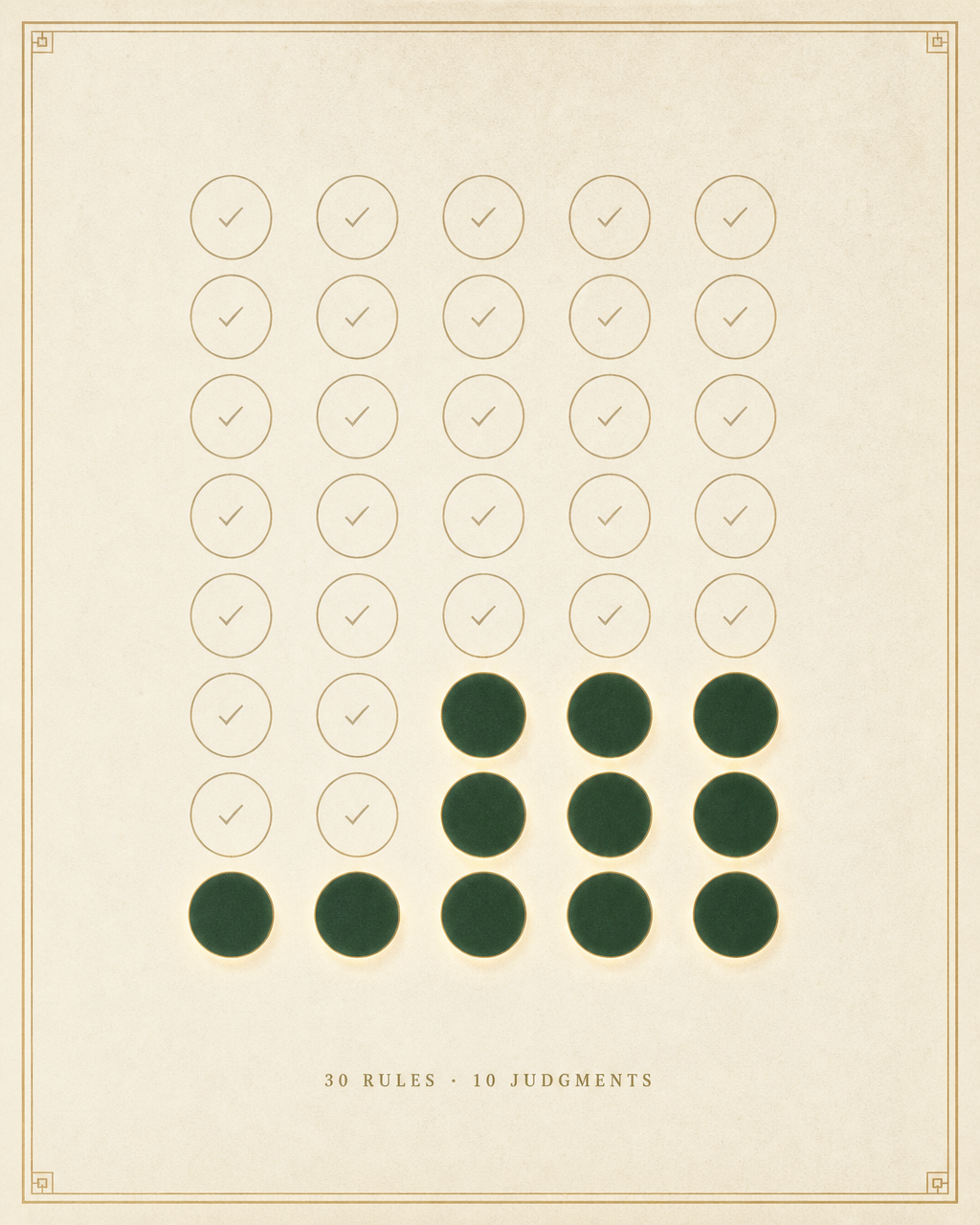
Here's a way to think about any job that I can't stop coming back to:
"A role is forty things. Thirty are a rule. Ten are the reason you hired a person. Automate the thirty."
Sit with that for a second, because it's doing more work than a nice LinkedIn quote card usually does.
Break your own job down for a second
Pick any role — sales rep, support agent, product manager, engineer, doesn't matter. Now list what actually fills their day. You'll notice it splits into two very different piles almost immediately.
Pile one is rule-following. Format the proposal. Check the field against the price list. Route the ticket to the right queue. Write the standard follow-up. Pull last week's numbers into the usual template. It's necessary, it's real work, and — this is the important part — it's describable. You could write the instructions down. Somebody already has, probably in a wiki nobody reads.
Pile two is judgment. Should we take this deal even though it breaks our normal terms? Is this customer actually angry, or just direct? Is this the right moment to push back on the client instead of accommodating them? You didn't hire this person because they could follow the wiki. You hired them because when the wiki runs out, they still make a good call.
Most roles really do split somewhere around 30/10. Call it a rough number, not gospel — but close enough to be useful.
This reframes the entire AI conversation
The scary version of the AI story goes: "AI is coming for your job." The accurate version is narrower and, honestly, more useful: AI is coming for the thirty. Not because it's being modest — because the thirty is the part that was never actually about you. It was about following a rule correctly and quickly. AI is extremely good at that. It should be doing it already.
The ten is a different animal entirely. It's not a bigger version of the same task — it's a different kind of task. It requires context AI doesn't have, stakes AI doesn't feel, and accountability AI can't hold. That's not a temporary gap that next quarter's model closes. It's a structural difference between following a rule and making a judgment call under uncertainty.
This is the same idea from a different angle as the autopilot story: automation absorbs the routine and concentrates human value into the exceptions. "Automate the thirty" is just the more quotable version of that.
The mistake both optimists and pessimists make
The AI optimist says "automate everything, humans become obsolete." The AI pessimist says "don't trust it with anything, keep a human on every step." Both are wrong in the same direction — both are treating the forty things as one undifferentiated blob instead of two genuinely different categories.
The actual work — the unglamorous, unsexy, extremely valuable work — is figuring out where your specific thirty ends and your specific ten begins. That line moves by role, by company, by industry. Nobody hands you the split. You have to actually go look at what your team does all day and sort it honestly, including the parts that are secretly closer to "we've always done it this way" than "this genuinely needs a human."
A quick gut-check for your own team
Ask, for any role: if this task went wrong, would we say "the process failed" or "they made a bad call"? Process-failed tasks are your thirty — they're candidates for automation, and honestly, they were always closer to a checklist than a talent. Bad-call tasks are your ten — protect the time your people spend there, because that's the actual job, and it's the part AI should be clearing space for, not competing with.
The point worth keeping
Nobody hired anyone for their ability to follow a rule quickly. That was always the warm-up act. Automate the thirty — not because the people doing it don't matter, but because the ten was the reason you hired them in the first place, and it's the only part of the job that was ever really about them.
Get the next essay the day it publishes.
A few a month, written from real builds. Unsubscribe in one click.

Senior product manager and builder — 15+ years shipping enterprise products (AT&T, BMW Group), now running his own with AI. These essays are field notes from that loop: what AI actually changes about work, product, and the economics underneath. Based in South Florida.
- Future of WorkYour AI Just Quoted a Client a Price. Can You Actually Deliver It?
Every CEO wants faster proposals. Almost nobody's asking the scarier question: does the AI writing them have any idea what your business can actually pull off?
5 min read - Future of WorkAutopilot Didn't Replace Pilots. AI Won't Replace Professionals.
Modern commercial flights spend most of their cruise time under autopilot. So why does every cockpit still carry two highly trained pilots? The answer explains exactly what AI is about to do to knowledge work.
5 min read - Future of WorkAI Isn't Artificial Intelligence. It's a Bicycle for the Mind.
Steve Jobs once described humans as a mediocre species on foot — until a bicycle made us the most efficient species on Earth. AI is the same kind of tool. But it also comes with an economic twist software has never had before.
7 min read